EN
EN



How a Footrest Relieves Leg Fatigue After Work
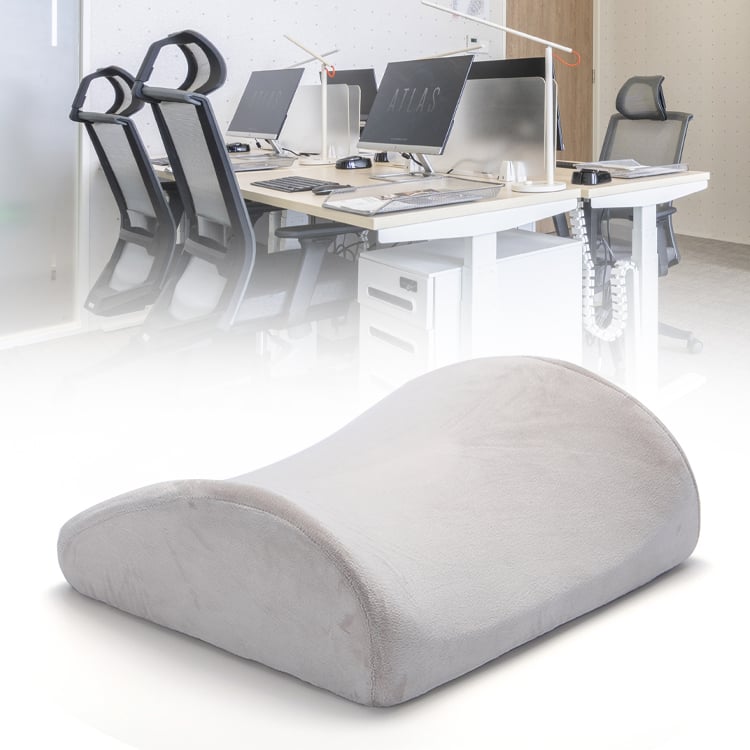
A 45-year-old accountant who had spent 25 years at a desk noticed progressive end-of-day leg fatigue — a dull ache from the knees down, mild ankle swelling by 5pm, and the habit of crossing and uncrossing her legs every few minutes in an unconscious attempt to relieve pressure. An ergonomic assessment identified the cause: her chair was adjusted to the correct height for her desk (elbows at 90 degrees, wrists flat on the keyboard), but this left her feet dangling 5cm above the floor — her chair's minimum seat height was 3cm higher than the distance from her knee crease to the floor. A 15cm-high memory foam footrest placed under the desk restored the 90-degree knee angle, supported the soles of both feet, and eliminated the dangling position. Within two weeks, the end-of-day ankle swelling resolved, and the leg fatigue that had been a daily feature of her work life for years diminished to occasional awareness after the longest days.
A footrest relieves leg fatigue by solving a biomechanical problem that affects anyone whose chair seat height exceeds their lower-leg length — a mismatch that is more common than not because standard office chairs and standard desk heights are designed for a 50th-percentile user, leaving the 40% of adults shorter than this reference height with unsupported feet.
Three physiological mechanisms produce the leg fatigue that a footrest addresses. Venous pooling occurs when the feet hang unsupported below the chair — gravity pulls blood into the lower legs, and the calf muscle pump (which normally assists venous return by contracting during walking and standing) is inactive in the seated position. The blood accumulates in the veins of the lower leg, increasing hydrostatic pressure and forcing fluid out of the capillaries into the surrounding tissue — the mechanism of dependent edema, visible as ankle swelling that increases through the workday.
Popliteal compression occurs when the chair seat front edge presses into the back of the thighs — a consequence of the feet not reaching the floor, which shifts the user's weight forward onto the thighs rather than distributing it through the feet and buttocks. The popliteal artery and vein behind the knee are compressed between the chair edge and the femur, reducing blood flow into and out of the lower leg. The user crosses and uncrosses their legs unconsciously to relieve the pressure — a behavior that temporarily restores circulation but does not solve the underlying foot-support problem.
The footrest height should equal the distance from the bottom of the user's foot to the floor when seated at the correct chair height — typically 10-20cm. The target is a 90-degree knee angle with the soles of both feet fully supported and the thighs parallel to the floor. An adjustable-height footrest accommodates multiple users or a sit-stand desk where the optimal footrest height changes with chair adjustment. A fixed-height footrest works for a single user whose chair height is consistent.
A footrest helps both — the 90-degree knee angle restores the pelvis to a neutral anterior tilt, which supports the lumbar spine's natural lordotic curve. When feet dangle, the pelvis tilts posteriorly (the tailbone tucks under), flattening the lumbar curve and increasing disc pressure in the L4-L5 and L5-S1 segments. The footrest corrects this pelvic tilt, reducing lower-back disc loading during prolonged sitting.
Medium-density memory foam (3-4 lbs/ft³, 50-65 kg/m³) with a removable, washable cover — the foam conforms to the foot's arch and distributes pressure across the entire sole surface rather than concentrating it at the heel and ball. Rigid plastic or wood footrests provide consistent height but concentrate pressure on the heel — acceptable for short-duration use but less comfortable over 6-8 hour workdays. Rocking footrests (curved bottom surface allowing ankle flexion and extension) add the benefit of active calf muscle movement, which engages the muscle pump and improves venous return.
A footrest reduces one risk factor for DVT — venous stasis in the lower legs — by restoring the knee angle that allows unobstructed venous return. However, a footrest alone does not eliminate DVT risk — periodic standing, walking, and calf muscle activation (ankle pumps: pointing and flexing the toes 10-20 times every hour) are necessary. The footrest reduces baseline venous stasis; movement interrupts it completely.
Either, but the footrest height should be adjusted to account for the shoe sole thickness (typically 1-3cm). A user who removes their shoes at the desk reduces their effective lower-leg length by 1-3cm — the footrest height should be increased by the same amount to maintain the 90-degree knee angle. A footrest with a textured or non-slip surface accommodates both options without the feet sliding.
In sitting mode, the footrest provides the standard 90-degree knee angle support. In standing mode, a footrest with a curved or angled top surface allows the user to place one foot on the elevated surface in a staggered stance — one foot on the floor, one foot elevated 10-15cm. This staggered position reduces the static load on the lumbar spine compared to standing with both feet flat. Alternating the elevated foot every 10-15 minutes engages the hip flexors asymmetrically, reducing the lower-back fatigue that accompanies prolonged static standing.

Established in 2007, Welldo is a manufacture and trader specialized in the research, development and production of all kinds of memory foam pillows. We are located in Xiamen, with convenient transportation access. All of our products comply fit international quality standards and are greatly appreciated in a variety of different markets throughtout the world. In order to further enhance the company's strength and competitive edge, and at the same time respond to the call of the country