EN
EN



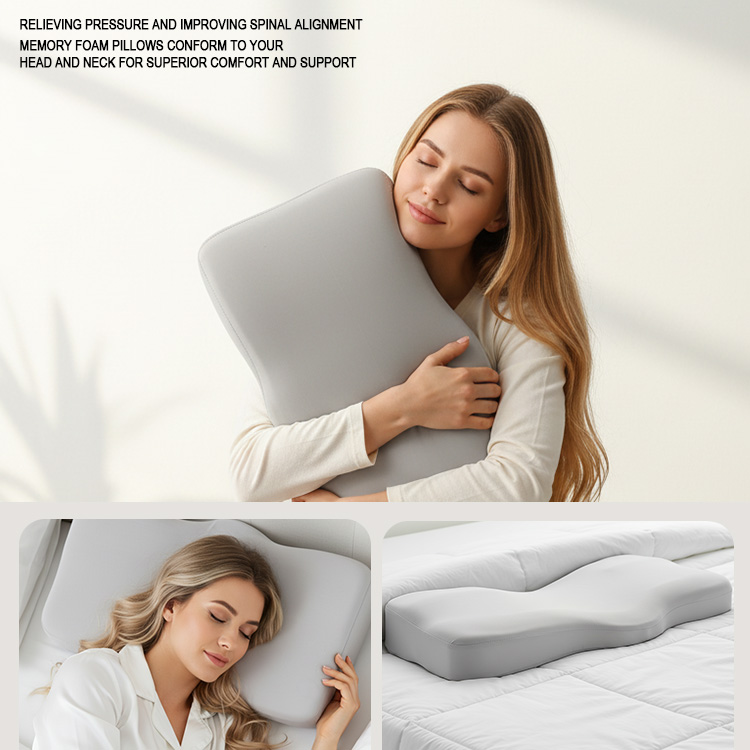
Pick a Comfortable Sleep Pillow for Side Sleepers
A 38-year-old side-sleeping physical therapist tested six sleep pillow options over three months to solve her own morning neck stiffness — a problem she understood biomechanically but had not solved for herself. Standard rectangular pillows at 15cm loft compressed to 6-8cm under head weight — too low to fill the 12cm gap between her neck and the mattress, leaving her cervical spine laterally flexed toward the mattress all night. A contoured memory foam pillow at 12cm neck-support height with a 7cm head-cradle section maintained neutral spinal alignment — the lateral X-ray she captured (with colleague assistance) showed the cervical vertebrae in a straight line from C1 to C7, parallel to the mattress plane. Her morning neck stiffness resolved within five nights.
Selecting a comfortable sleep pillow for side sleeping requires matching the pillow's loft (height), firmness, and shape to the user's shoulder width and mattress firmness — a biomechanical matching problem that explains why pillows that receive 10,000 five-star reviews still generate returns from the 15-20% of buyers whose body dimensions differ from the pillow's design target.
Side sleeping creates a gap between the neck and the mattress that the pillow must fill. The gap distance equals the horizontal distance from the outer edge of the shoulder to the side of the neck at the C5-C6 vertebral level — approximately 10-15cm for an average-build adult. A pillow that compresses to a height less than this gap leaves the neck unsupported; the cervical spine bends laterally toward the mattress, compressing the intervertebral discs on the lower side and stretching the muscles and ligaments on the upper side. Sustained for 6-8 hours, this position produces the morning neck stiffness and cervicogenic headache that side sleepers disproportionately experience.
A sleep pillow that compresses to a height greater than the neck-to-mattress gap produces the opposite problem — the neck bends away from the mattress, compressing the opposite-side discs. The ideal pillow height is the user's neck-to-mattress gap distance minus 1-2cm to account for mattress compression under the shoulder — a firm mattress does not compress, so the full gap distance applies; a soft mattress allows the shoulder to sink 2-4cm into the surface, reducing the effective gap.
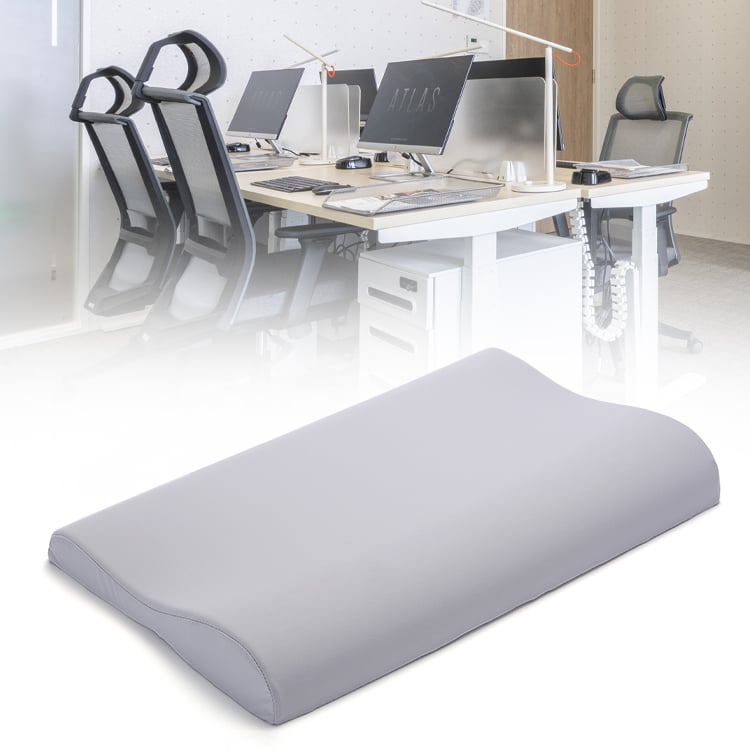
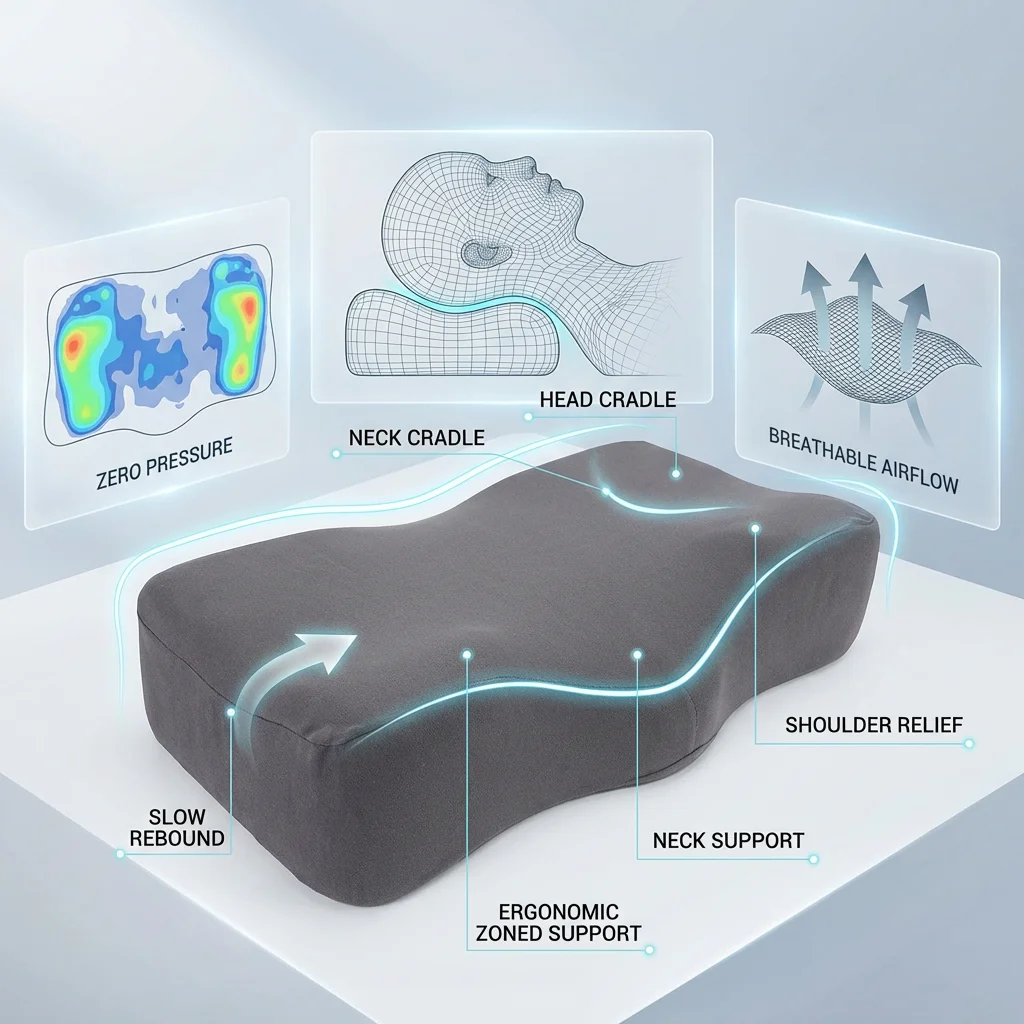
Medium-density memory foam at 3-5 lbs/ft³ (50-80 kg/m³) with a contoured shape — raised neck-support section (10-13cm) and lower head-cradle section (6-8cm) — is the configuration that most consistently satisfies side sleepers' requirements. The contour design addresses the fact that the neck and the head require different support heights: the neck needs elevation to fill the gap; the head needs a lower surface to avoid being pushed upward into flexion.
The foam density determines how the pillow responds to the head's weight (approximately 5kg, but effectively 3-4kg because the pillow also supports the neck and part of the shoulder). At 3 lbs/ft³, the foam compresses approximately 40-50% under head weight — a 12cm loft pillow compresses to 6-7cm, which fills the neck-to-mattress gap for an average-build user on a medium-firm mattress. At 5 lbs/ft³, the same 12cm loft compresses only 25-30% to 8-9cm — suitable for a broader-shouldered user with a 14-15cm gap requirement.
10-15cm compressed height (the pillow's height under head weight, not its unloaded loft). The precise height equals the distance from the outer shoulder edge to the side of the neck — measured with a ruler while lying on the side on a firm surface. Users with broad shoulders (men's jacket size 44+, women's 16+) typically need 13-15cm; average builds need 10-12cm. A pillow that is too low causes neck lateral flexion toward the mattress; too high causes lateral flexion away from the mattress.
Memory foam is preferred for side sleepers because it conforms to the neck and head shape, distributing pressure across the contact surface. Latex pushes back — it maintains a consistent support surface but does not conform to individual anatomy. Side sleepers with broad, angular shoulder profiles benefit from memory foam's conforming behavior; side sleepers who change position frequently during the night may prefer latex's faster response time.
Contoured — a raised neck-support section (10-13cm) and a lower head-cradle section (6-8cm) — with a center depression that cradles the head. The contour aligns with the cervical spine's natural lordotic curve, supporting the neck while allowing the head to rest in a neutral position. Standard rectangular pillows at uniform height cannot simultaneously provide adequate neck elevation and prevent the head from being pushed upward into flexion.
A firm mattress prevents the shoulder from sinking — the full neck-to-mattress gap applies, requiring a higher pillow loft (12-15cm). A soft mattress allows the shoulder to sink 2-4cm, reducing the effective gap and requiring a lower pillow loft (8-12cm). The same pillow that works perfectly on a medium-firm mattress may be too low on a firm mattress or too high on a soft mattress.
Yes — side sleeping places more of the face in contact with the pillow surface than back sleeping, increasing heat transfer from the face to the pillow. Gel-infused memory foam, a phase-change material cover, or a breathable open-cell foam structure reduces surface temperature by 2-4°C compared to standard memory foam. The cooling effect matters more for side sleepers than back sleepers because the larger contact area transfers more heat.
18-24 months for 3-4 lbs/ft³ memory foam, 24-36 months for 5 lbs/ft³ foam. The failure mode is permanent compression set in the neck-support section — the raised contour no longer recovers to its full height, and the user compensates by folding the pillow or adding a second pillow, both of which create alignment problems. The fold test is diagnostic: fold the pillow in half and release. If the pillow does not spring back to full height within 5 seconds, the foam has exceeded its useful life. Side sleepers experience faster foam degradation than back sleepers because the concentrated pressure under the neck accelerates compression set.

Established in 2007, Welldo is a manufacture and trader specialized in the research, development and production of all kinds of memory foam pillows. We are located in Xiamen, with convenient transportation access. All of our products comply fit international quality standards and are greatly appreciated in a variety of different markets throughtout the world. In order to further enhance the company's strength and competitive edge, and at the same time respond to the call of the country