EN
EN



Sitting transforms the spine’s natural S-curve into a C-shaped slouch. The lower back’s inward arch flattens or reverses, compressing the front edges of the vertebral discs while pushing the nucleus pulposus backward—creating uneven intradiscal stress. At the L4-L5 segment, intradiscal pressure can rise by up to 40% in strict 90-degree seated posture compared to a slightly reclined position. This sustained compression impairs nutrient diffusion in the avascular disc tissue, accelerating degenerative changes. As postural muscles fatigue over hours of static sitting, passive spinal structures bear increasing load—triggering low-grade inflammation and mechanical strain that manifest as waist soreness, even in otherwise healthy individuals.
Pelvic posterior tilt during prolonged sitting causes deep spinal stabilizers—the erector spinae and multifidus—to deactivate, as confirmed by electromyography. Without active muscular support, the lumbar spine relies on ligaments and the disc annulus to maintain posture. This passive loading stretches the posterior ligamentous complex and induces creep deformation: gradual, irreversible elongation of connective tissues under constant stress. The result is micro-damage and nociceptive signaling. Over time, this deactivation becomes habitual, impairing the ability to re-engage stabilizers even when standing—contributing to recurrent waist soreness and stiffness.
The lumbar spine’s natural lordotic curve is essential for distributing mechanical loads evenly across vertebrae. Unsupported sitting collapses this curve, rotating the pelvis posteriorly and stretching passive structures like the posterior longitudinal ligament and thoracolumbar fascia. In response, the erector spinae and multifidus either overwork futilely or shut down entirely—a phenomenon known as flexion-relaxation. With muscles deactivated, inert tissues bear excessive stress, hastening fatigue and microtrauma.
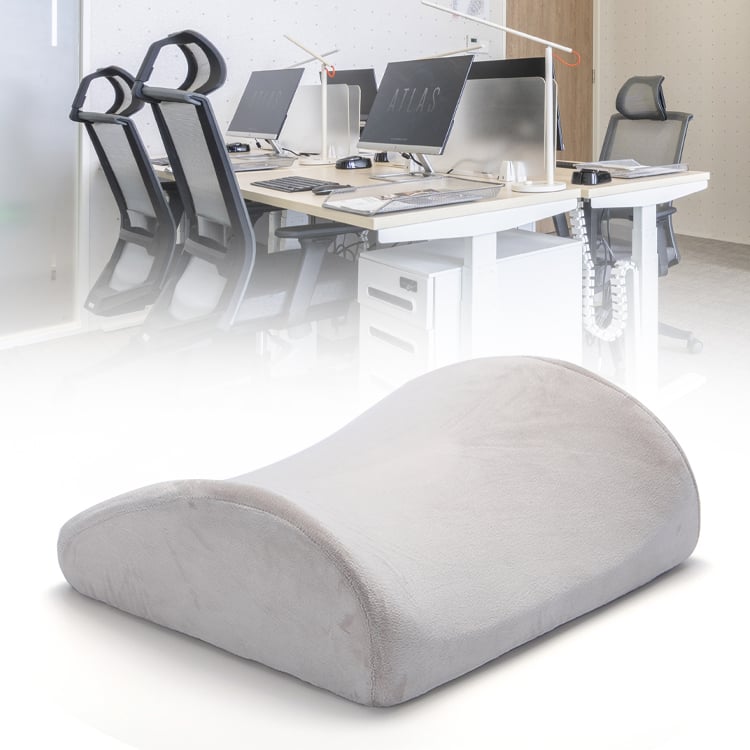
A properly positioned lumbar support fills the gap between the lower back and chair backrest, gently encouraging anterior pelvic tilt and restoring near-neutral lordosis—typically at the L3 to L5 level. This enables the deep paraspinous muscles to engage functionally rather than leaving ligaments overloaded. Studies confirm that such support reduces myoelectric activity in the iliocostalis and longissimus muscles by 20 to 30%, reflecting lower activation demands. Leading ergonomic chairs now feature dual-adjustment systems to accommodate anatomical variation—without forcing hyperextension, the support simply restores a biomechanically efficient baseline.

Direct intradiscal pressure measurements show that unsupported sitting increases L4-L5 pressure by roughly 40% versus standing—while properly aligned lumbar support reduces it by 25 to 40%, bringing pressure close to upright standing levels. MRI studies corroborate this, demonstrating reduced posterior migration of the nucleus pulposus—a key contributor to discogenic pain. By preserving lordosis, lumbar support redistributes compressive forces more evenly across the disc surface, lowering peak stress on the vulnerable posterior annulus. The table below summarizes observed pressure changes:
| Postural Condition | Intradiscal Pressure at L4-L5 (Relative to Standing) | Clinical Implication |
| Standing Upright | 100% (Baseline) | Reference point for physiological load |
| Unsupported Sitting (Flexed) | 140% | High posterior disc stress, elevated herniation risk |
| Sitting with Lumbar Support (Lordotic) | 100 to 115% | Restored pressure profile, reduced passive tissue strain |
A 30% pressure reduction at L4-L5 meaningfully offloads the posterior disc wall—the most common site for annular tears and herniation—confirming lumbar support as a biomechanical intervention, not merely a comfort feature.
The most common error is positioning lumbar support at the beltline, which presses against the sacrum or mid-back instead of the lumbar curve. Optimal placement targets the L4-L5 vertebrae—approximately 2 to 3 inches above the iliac crests. At this level, the support maintains anterior convexity and prevents pathological flattening. Evidence confirms that L4-L5-aligned support delivers the full 25 to 40% intradiscal pressure reduction, directly protecting the posterior annulus. Aim for 20 to 40 millimeters of forward projection—firm but gentle contact—and adjust vertically until you feel even, comfortable engagement across the low back.
Lumbar support works best within an integrated ergonomic system. Seat depth should allow 2 to 3 fingers of space between the seat edge and popliteal fossa, ensuring pelvic contact with the support when reclining. A slight forward seat tilt of 5 to 10 degrees opens the hip angle, promoting natural lordosis and preventing forward sliding. Backrest angle matters too: a 100 to 110-degree recline shifts weight onto the chair back, reducing spinal load by roughly 30%. Finally, incorporate micro-movements—brief pelvic tilts, weight shifts, or standing breaks every 25 to 30 minutes—to interrupt static loading. These synergistic adjustments amplify the biomechanical benefit of correctly placed lumbar support.
A Cochrane systematic review of randomized controlled trials provides the highest-quality evidence on lumbar support for non-specific low back pain. It finds moderate-certainty support for short-term relief: users report an average 1.8-point reduction on a 10-point Visual Analogue Scale. While not curative, this improvement is clinically meaningful, translating to tangible comfort gains during extended sitting. The mechanism is clear: external support modifies sitting biomechanics to reduce immediate mechanical strain and nociceptive input.
Long-term efficacy remains less certain due to real-world constraints. Compliance is inconsistent—many discontinue use once acute discomfort subsides or apply supports incorrectly. Device quality varies widely, from basic foam rolls to precision-engineered adjustable inserts, each delivering different biomechanical outcomes. This reinforces that lumbar support is not a standalone solution. It functions best as one component of a broader strategy—including ergonomic chair setup, frequent movement, and progressive core strengthening. Relying on it alone to counteract chronic sedentariness misunderstands its role: it is a targeted, evidence-informed tool, not a substitute for active self-management.
Why does sitting cause waist soreness?
Prolonged sitting leads to compression of the lumbar discs, flattening of the spine’s natural curve, and deactivation of key stabilizing muscles, which can stress passive structures and trigger soreness.
How does lumbar support help reduce waist soreness?
By restoring the spine's natural neutral curve, lumbar support reduces intradiscal pressure and passive tissue stress, allowing for even load distribution and muscle activation.
Where should I place my lumbar support for the best results?
Position lumbar support at the L4-L5 vertebrae, approximately 2 to 3 inches above the iliac crests, for optimal alignment and pressure reduction.
Can lumbar support completely eliminate back pain?
No, lumbar support is a helpful tool but not a standalone cure. It works best in combination with ergonomic adjustments, movement breaks, and core strengthening.

Established in 2007, Welldo is a manufacture and trader specialized in the research, development and production of all kinds of memory foam pillows. We are located in Xiamen, with convenient transportation access. All of our products comply fit international quality standards and are greatly appreciated in a variety of different markets throughtout the world. In order to further enhance the company's strength and competitive edge, and at the same time respond to the call of the country